2010-09-25

False Positives in Database Integration Tests

You may sometimes find that all your tests pass, but in production your entities cannot be hydrated from the database. Take this example:

@PersistenceContext(unitName="shipmentOrder")
EntityManager entityManager;

@Test
@Transactional
public void maps_correctly_to_and_from_database() throws Exception {

	ShipmentOrder state = new ShipmentOrder();
	state.setCustomerName("CALLERNAME");
	state.getDeliveryAddress().setCountry("NIRVANA");

	entityManager.persist(state);
	entityManager.flush(); // enforce writing to the database

	ShipmentOrder foundState = entityManger.find(ShipmentOrder.class, state.getId());

	assertEquals("CALLERNAME", foundState.getCustomerName());
	assertEquals("NIRVANA", foundState.getDeliveryAddress().getCountry());
}

This test will happily pass, but the same call fails in production. Why?

Below are the entity classes - note, that JPA by default does not allow @Embeddable's to inherit (see e.g. the Hibernate Annotations Reference, section "3.2.4.4. Inherit properties from superclasses" for more details). Even worse, Hibernate does not complain, but silently ignores inherited fields.

@Entity
class ShipmentOrder {
	String customerName;
	@Embedded
	DeliveryAddress deliveryAddress;

	String getCustomerName() { return customerName; }
	DeliveryAddress getDeliveryAddress() { return deliveryAddress; }
}

@Embeddable
class DeliveryAddress extends Address{
	String deliveryLocation;
	String getDeliveryLocation();
}

class Address {
	String country;
	String getCountry();
}

So, why does the test pass then?

The problem is, that while within a transaction, Hibernate reuses objects from the 1st Level cache. This means the our call to "flush()" causes Hibernate to write changes to the database, but the entity instance is still kept in memory. If we execute the find() method, Hibernate simply returns the entity instance from the cache and will never try to hydrate the instance from the database.

Solution

EntityManager.clear() allows to manually purge the 1st level cache. Changing the test to

repository.store(state);
entityManager.flush(); // enforce writing to the database

entityManager.clear(); // purge 1st level cache

state = repository.findById(state.getId());

will successfully catch the mapping error.

Here is a method we use in integration tests to automatically flush+purge all persistence contexts defined in Spring:

protected void flushAndClearPersistenceContexts() {
    Map<String, EntityManagerFactory> entityManagers = this.getApplicationContext().getBeansOfType(EntityManagerFactory.class);
    for(EntityManagerFactory emf:entityManagers.values()) {
        EntityManagerHolder emHolder = (EntityManagerHolder) TransactionSynchronizationManager.getResource(emf);
        if (emHolder != null) {
            final EntityManager entityManager = emHolder.getEntityManager();
            try {
                entityManager.flush();
            } catch (TransactionRequiredException e) {
                // ignore - couldn't find a way to properly check if we are within a transaction
            }
            entityManager.clear();
        }
    }
}

NOTE: never use flush() and clear() in your production code as this seriously kills the performance of hibernate

You can find the sample code reproducing this issue on my git repository.

2010-01-25

The Danger Of Mislead Solutions: Constructor Over-Injection

Recently Jeffrey Palermo blogged about something he calls "constructor over-injection anti-pattern". This post caused a couple of reactions, in particular Mark Seemann's rebuttal to be mentioned. Mark Seemann already did a nice job arguing against the tight coupling in Jeffrey's proposed solution of (taken from the follow-up)

IOrderShipper shipper = new OrderShipperFactory().GetDefault();

to lazily resolve the IOrderShipper reference. Although I agree with Mark, that those lines are as wrong as possible and introduce an even worse smell than the one Jeffrey tried to cure, I disagree with him, that the problem here is the dependency on a concrete type and that we're dealing with the servicelocator antipattern. The real problem with this solution is that it is only a variant of the singleton pattern. Misko Hevery wrote a nice post, why the singleton pattern is a really bad idea.

What's The Problem?

Let's take a step back and look at Jeffery's original problem. He started with the problem, that it took a long time to instantiate the OrderProcessor because of the constructor-dependency on an IOrderShipper. From the fact, that IOrderShipper is not used by OrderProcessor in 100% of the cases, he draws the conclusion, that IOrderShipper should not be a mandatory argument to the OrderProcessor, thus effectivly turning IOrderShipper into an optional dependency of OrderProcessor.

Is IOrderShipper Really Optional?

What does making IOrderShipper an optional dependency of OrderProcessor buy us? Of course OrderProcessor get's initialized much faster now. But this comes at a price. By removing the dependency from the constructor (or passing it in via .NET 4.0's Lazy<> as some suggested), we are giving up some important advantages.

For one, we won't get any notice if there's anything wrong with the IOrderShipper until it is actually needed. There might be an important resource like a database not available, a configuration error or whatever. Only when the first user enters a valid order, this user will experience an error. This violates the fail fast & early principle.

If everything is configured correctly, this first user also will experience a surprising delay while the system is processing his order, as he has to wait until the IOrderShipper is available. This breaks the principle of least surprise.

The Real Problem: IOrderShipper

After all, it is to expect, that the majority of our users will enter a valid order. The conclusion, that IOrderShipper is an optional dependency, is simply plain wrong when looking at the real world scenario. Thus making IOrderShipper an optional dependency of OrderProcessor due to performance issues when instantiating the object graph is just curing a symptom. It is not about healing the real problem: the terrible performance of instantiating the IOrderShipper.

The lesson I learned from this exercise: always carefully evaluate, that you're drawing the right conclusions from your analysis. It is sometimes too tempting to take the easy path or be mislead and in doing so introduce even bigger problems in the long run than the one currently at hand.

As a sidenote, I absolutely agree with Jeffrey, that IoC containers are just tools and your application's design should not rely on your container's features. After all, non-invasiveness is one of the fundamentals of IoC.

So Constructor Over-Injection Is Not An Issue?

In his second post, Jeffrey introduces even more dependencies into OrderProcessor to proof his point. I have to admit, that services classes sometimes tend to grow and serve as a sort of "feature attractors". In my next post I will look into this problem and provide some thoughts on why this is a problem and how to solve it.

2010-01-10

Spring.NET AOP - Behind The Scenes (3)

In the last installment of this series I showed you how you can leverage Spring.NET's ProxyFactory to wrap an object with a proxy and add interceptors to this proxy in order to enrich the behavior of your object's methods without having to changing a single line of code. Nevertheless it is quite cumbersome to wrap each single object explicitely.

Describing the "Where To Apply"

What we are looking for is a more automated approach, where we just want to describe the objects or - more fine grained - methods that we want to have a particular behavior applied. An interceptor ("Advice" in AOP terms) only describes *what* to do (e.g. retrying an operation), thus we need a way to describe *where* to apply it. In AOP terms, every method that can be wrapped by an interceptor is called a Joinpoint.

image

Of course we can taxatively enumerate the list of joinpoints that we want a particular advice to be applied like this:

Apply RetryInterceptor At
CalculatorWebService.Add
CalculatorWebService.Divide
...

but this clearly is not what we really want as in larger applications this quickly requires us to list each and every joinpoint in this list. What want to say something along the lines of

Apply RetryInterceptor At
All Service Methods

Looks much clearer, but how shall we describe that? You can compare it to selecting records from a database table. What we are dealing with here is a set of possible joinpoints and our "where" clause describes the characteristics of those joinpoints that we want to capture by our select statement. Applying this to our example, we can e.g. write

Apply RetryInterceptor At
ClassName LIKE '*Service' AND MethodName LIKE '*'

In AOP terms, such a SELECT statement, selecting a subset of joinpoints out of all possible joinpoints, is called a Pointcut.

image

Applying Advices to Pointcuts: Entering Object Post-Processors

Now that we have an idea, how we may select a set of joinpoints based on some criteria, how can we apply this technically? Remember, that in Spring you describe your objects using object definitions, a sort of recipe, that tells Spring how to instantiate and configure a particular object. Here's an example of such construction recipes in XML:

<object name="Alice" type="Spring.Objects.TestObject">           
<property name="age" value="31"/>
</object>

<object name="Bob" type="Spring.Objects.TestObject">
<property name="age" value="33"/>
<property name="spouse" ref="Alice" />
</object>

Using such object definitions we can build up whole object graphs, Since instantiation of these objects happens under control of Spring, we can leverage one of Spring's extension points to manipulate an object once it gets instantiated. This extension point is called "object post-processing". Everytime an object gets instantiated, Spring hands this object to all configured objects that implement the interface IObjectPostProcessor:

image

This is exactly what we need! We can implement our own IObjectPostProcessor to wrap the target instances within a proxy as needed. A simple implementation using a predicate for deciding which objects to wrap looks like this:

public class CustomAutoProxyCreator : IObjectPostProcessor
{
private readonly Func<object, string, bool> matchesPointcut;
private readonly IMethodInterceptor[] advices;

public CustomAutoProxyCreator(Func<object, string, bool> matchesPointcut,
                              params IMethodInterceptor[] advices)
{
  this.matchesPointcut = matchesPointcut;
  this.advices = advices;
}

public object PostProcessBeforeInitialization(object instance, string objectName)
{
  return instance;
}

public object PostProcessAfterInitialization(object instance, string objectName)
{
  if (matchesPointcut(instance, objectName))
  {
    ProxyFactory proxyFactory = new ProxyFactory(instance);
    foreach(var advice in advices)
    {
      proxyFactory.AddAdvice(advice);
    }
    return proxyFactory.GetProxy();
  }
  return instance;
}
}

We can now add this CustomAutoProxyCreator to our configuration in order to apply caching and retry behaviors to every object, who's object name ends with "*Service":

[Configuration]
public class AutoProxyDemoConfig
{
public CalculatorWebService TheCalculatorService()
{
  return new CalculatorWebService();
}

public CustomAutoProxyCreator AutoProxyCreator()
{
  return new CustomAutoProxyCreator(
      (instance, name) => name.EndsWith("Service"),
      new CacheInterceptor(), new RetryInterceptor()
  );
}
}

Reusing Spring.NET's AutoProxy Facilities - DefaultAdvisorAutoProxyCreator

Of course you don't need to implement your own IObjectPostProcessor for automatically creating AOP proxies. Spring.NET already comes with a predefined set of implementations that allow you to choose from various strategies for automatically creating proxies, DefaultAdvisorAutoProxyCreator (DAAPC) being the most flexible and powerful one.

What makes DAAPC so powerful? Remember our initial discussion about pointcuts and advices. DAAPC allows you to simply add such combinations of pointcuts and advices to the container configuration and will automatically pick them up to do it's magic. For this reason, Spring.NET introduced a special kind of object, a so called "Advisor". An advisor is nothing else than a combination of a pointcut and an advice to apply at this pointcut:

image

To leverage DAAPC, add a DAAPC and a list of advisors as needed to your container configuration. DAAPC then will automatically pickup these advisors and apply them. The following example demonstrates, how to apply our advices using this technique:

[Configuration]
public class DefaultAdvisorAutoProxyDemoConfig
{
public CalculatorWebService TheCalculatorService()
{
  return new CalculatorWebService();
}

public DefaultAdvisorAutoProxyCreator AutoProxyCreator()
{
  return new DefaultAdvisorAutoProxyCreator();
}

public DefaultPointcutAdvisor CacheServiceCallResultsAdvisor()
{
  return new DefaultPointcutAdvisor(
    new SdkRegularExpressionMethodPointcut(@".*Service\.*"),
    new CacheInterceptor()
  );
}

public DefaultPointcutAdvisor RetryServiceCallResultsAdvisor()
{
  return new DefaultPointcutAdvisor(
    new SdkRegularExpressionMethodPointcut(@".*Service\.*"),
    new RetryInterceptor()
  );
}
}

The advantage of this technique is, that whenever you want to apply a new advice, you just need to add new advisors to your definition and DAAPC automatically will pick them up and apply them.

And now the end is near...

What a journey. We started by identifiying cross-cutting concerns, refactoring them into separate classes using the decorator pattern. By introducing interceptors we made those behaviors reusable across different target classes. Using ProxyFactory, we even don't have to write any proxy code anymore. Finally, using pointcuts and Spring.NET's AutoProxy facilities, we can easily apply advices on any set of objects as needed. By following common sense and step-by-step refactoring, we almost naturally ended up at this mysterious technique called Aspect-Oriented Programming and proofs that there is nothing magically behind this concept. Also it proofs, that Object-Oriented Programming and Aspect-Oriented Programming are not mutually exclusive, but perfectly work together to tame today's application's complexities.

Nevertheless we are not done yet. Until now we have only discussed the technical solution, how to implement AOP. In my next post I will discuss, when to use AOP and point out a couple of issues you have to consider when applying AOP.

As usual, you can download the sample code for this post.

2010-01-04

Spring. NET AOP - behind the scenes (2)

This is the second installment of my series about the internals of Spring.NET AOP. In my first post of this series I described the first step in separating concerns and how we can use the decorator pattern to make our code much better maintainable. Nevertheless we were still left with two major problems:

  • Changing an interface to our service requires all decorators to be changed
  • Lack of reusing decorator logic for other services

A more generic approach: Interceptors

As mentioned, we can do better. Assume we have other services in our application. We do not want to implement the caching or retry code each time and for every method. Code duplication is the root of all evil. Thus we need to improve our solution. First, let's refactor our retry code into a separate class, that can be used to wrap any arbitrary method call. We will introduce a special interface for these added behaviors and call them interceptors:

public interface IMethodInterceptor
{
 object InvokeMethod(Func<object> invokeNext);
}

An interceptor implementation gets passed in a delegate. This delegate can either be the method we are wrapping or even another interceptor. The method we are wrapping is usually called the target method. When the delegate is another interceptor, we refer to this as an interceptor chain, with each interceptor adding its own behavior before calling the target method. Our Retry-interceptor then looks like this:

public class RetryInterceptor : IMethodInterceptor
{
 public object InvokeMethod(Func<object> invokeNext)
 {
   int retries = 0;
   while (true)
   {
     try
     {
       return invokeNext();
     }
     catch (Exception ex)
     {
       retries++;
       if (retries >= 3)
       {
         throw; // retry threshold exceeded, giving up
       }
       Thread.Sleep(1000); // wait a second
     }
   }
 }
}

Notice, that our RetryInterceptor now is absolutely unaware of the target method or its arguments. It just gets passed in a delegate to invoke, which hands over control to either the next interceptor in the chain or the actual target method.

Now we can implement our interceptor chain in a rather generic way, we will call it our CalculatorProxy and hand it our actual target instance and a list of interceptors. The actual method invocation is a bit tricky, but doable:

public class CalculatorProxy : ICalculator
{
 private ICalculator target;
 private IMethodInterceptor[] interceptors;

 public CalculatorProxy(ICalculator target, IMethodInterceptor[] interceptors)
 {
   this.target = target;
   this.interceptors = interceptors;
 }

 public int Add(int x, int y)
 {
   return (int) InvokeInterceptorAtIndex(0, ()=>target.Add(x, y));
 }

 private object InvokeInterceptorAtIndex(int interceptorIndex, Func<object> targetMethod)
 {
   if (interceptorIndex >= interceptors.Length)
   {
     return targetMethod();
   }
   return interceptors[interceptorIndex].InvokeMethod(
           () => InvokeInterceptorAtIndex(interceptorIndex + 1, targetMethod)
       );
 }
}

This proxy implementation accepts calls coming in over the ICalculator.Add() interface method and passes control to the first interceptor in the chain. Initialize our proxy like this:

ICalculator calc = new CalculatorProxy(
                       new CalculatorWebService(),
                       new IMethodInterceptor[] { new RetryInterceptor() });
int sum = calc.Add(2, 5);

Each interceptor will invoke the next interceptor in the list if available or the final target:
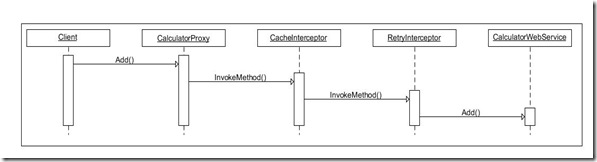
calculatorproxy_callgraph

We have just implemented a mechanism that allows us to add any arbitrary number of interceptors to our proxy!

Generating Proxies - Spring's ProxyFactory

Of course we implemented our interception mechanism for one method only yet. Assume we have to extend the capabilities of our remote calculator and add a new Divide() method. How would the proxy implementation of this method look like? Look at this:

public double Divide(double dividend, double divisor)
{
 return (int)InvokeNext(0, () => target.Divide(dividend, divisor));
}

Comparing this implementation to our previous Add() implementation, the pattern becomes obvious. Both methods hand control to the first interceptor and pass in a delegate to the actual method invocation. No matter how many methods we add, this code will always look the same. Let's refactor the common code for invoking the interceptor chain into a base class AbstractProxy:

public abstract class AbstractProxy
{
 private IMethodInterceptor[] interceptors;

 public AbstractProxy(IMethodInterceptor[] interceptors)
 {
   this.interceptors = interceptors;
 }

 protected object InvokeInterceptorAtIndex(int interceptorIndex, Func<object> targetMethod)
 {
   if (interceptorIndex >= interceptors.Length)
   {
     return targetMethod();
   }
   return interceptors[interceptorIndex].InvokeMethod(
       () => InvokeInterceptorAtIndex(interceptorIndex + 1, targetMethod)
     );
 }
}

Our CalculatorProxy then will be:

public class CalculatorProxy : AbstractProxy, ICalculator
{
 private readonly ICalculator target;

 public CalculatorProxy(ICalculator target, IMethodInterceptor[] interceptors)
   : base(interceptors)
 {
   this.target = target;
 }

 public int Add(int x, int y)
 {
   return (int)InvokeInterceptorAtIndex(0, () => target.Add(x, y));
 }

 public double Divide(double dividend, double divisor)
 {
   return (int)InvokeInterceptorAtIndex(0, () => target.Divide(dividend, divisor));
 }
}

Even if we implemented other interfaces, these lines would be the same. Luckily, Castle.DynamicProxy, LinFu and of course Spring.NET come with mechanisms that allow this code to be generated at runtime. Below I will show you, how you can use Spring.NET's ProxyFactory to automatically generate this proxy code.

First, to make our interceptor compatible to Spring.NET, we need to implement Spring.NET's IMethodInterceptor interface for our interceptors (instead of our own IMethodInterceptor interface as described above):

public class RetryInterceptor : IMethodInterceptor // Spring.NET's interceptor interface!
{
 public object Invoke(IMethodInvocation invocation)
 {
   int retries = 0;
   while (true)
   {
     try
     {
       return invocation.Proceed();
     }
     catch (Exception ex)
     {
       retries++;
       if (retries >= 3)
       {
         throw; // retry threshold exceeded, giving up
       }
       Thread.Sleep(1000); // wait a second
     }
   }
 }
}

Notice, that instead of getting passed in a method delegate, Spring.NET's IMethodInterceptor.Invoke() receives an instance of IMethodInvocation and calls Proceed() to hand control to the next interceptor or target method in the chain. In contrast to the simple delegate that we used in our manually coded proxy, the IMethodInvocation interface allows you to access additional information about the current method call:

public interface IMethodInvocation
{
 /// <summary>
 /// Get the proxy instance for the current method invocation
 /// </summary>
 object Proxy { get; }
 /// <summary>
 /// Get the target instance for the current method invocation
 /// </summary>
 object Target { get; }
 /// <summary>
 /// Get the method info for the current method invocation
 /// </summary>
 MethodInfo Method { get; }
 /// <summary>
 /// Get the arguments for the current method invocation
 /// </summary>
 object[] Arguments { get; }
 /// <summary>
 /// Hand control to next interceptor or target
 /// </summary>
 object Proceed();
}

Now that we have our interceptors ready, we can use Spring.NET's ProxyFactory to have the proxy class automatically generated for us. Note, that in the example below the method used to add an interceptor is called "AddAdvice". Advice is the common term to refer to an action to be taken before or after calling the actual target. For a more detailled description of common AOP terminology, please refer to the Spring.NET AOP reference. Here's the code to let Spring.NET generate such a proxy instance for us:

ProxyFactory proxyFactory = new ProxyFactory();
proxyFactory.Target = new CalculatorWebService(); // set target
proxyFactory.AddAdvice( new RetryInterceptor() ); // add interceptor

ICalculator calc = (ICalculator) proxyFactory.GetProxy(); // create proxy instance

The call to GetProxy() will generate a proxy instance, set the target and add the list of interceptors to the proxy. The result is the same structure we showed above and also the call graph of an interceptor chain looks very familiar:

calculatorproxyfactory_callgraph

The difference is, that we didn't have to write a single line of code for our proxy. This means that we now easily can reuse our RetryInterceptor across all kinds of classes in our application!

We want more!

Wow, what a journey. We started by separating concerns into their own classes by applying the decorator pattern, implemented our own proxy with a flexible method interception mechanism and finally saw, how Spring.NET's ProxyFactory can be used to do all of this for us automatically.

Is there anything left on our wishlist? Imagine we have a whole bunch of Service classes in our application that we would like to retry their operations. We'd have to execute the lines to create the proxy, set the target and add the interceptors for each service individually. What about a feature that allows you to just point to a list of objects and tell Spring.NET to wrap those objects in a proxy with a given list of interceptors?

Indeed the AOP framework of Spring.NET comes with a great feature called "AutoProxying" that makes it easy to automatically apply interceptors to a set of objects. Stay tuned to read how this feature works in the next post of this series!

As usual you can download the example code.

2009-12-31

Happy New Year!

Instead of a technical post, today I just want to wish a happy new year to everyone! The promised follow-up post of my AOP series will go online on January 4 in the next decade.

All the Best and I hope to see you again next year!

2009-12-28

Spring.NET AOP - behind the scenes (1)

On the forums I see one topic coming up quite often: "Can I advise XY?". In this multipart post series I will describe the motivation for AOP and the way Spring.NET AOP (and most others like Castle.DynamicProxy and LinFu) technically work in .NET to give you a better understanding and provide you the knowledge to help answering such questions yourself.

The example: Retrying operations

Instead of the usual logging example I'd like to show you another useful feature: Retrying operations. For the sake of simplicity let's assume we're calling a webservice method for calculating the sum of two integers.

CalculatorWebService calc = new CalculatorWebService("http:/...");
int sum = calc.Add(2, 5);

Since webservices usually involve calling over the network, they are inherently unsafe and might fail for various reasons. In our application, we would like to retry webservice operations 3 times before giving up, with a 1 second delay between retries.

There are a couple of ways to implement this requirement, the most direct approach probably by deriving our own class from the webservice client class:

public class RetryingCalculatorWebService : CalculatorWebService
{
  public RetryingCalculatorWebService(string url):base(url) {}   

  public override int Add(int x, int y)
  {
    int retries = 0;
    while (true)
    {
      try
      {
        return base.Add(x, y);
      }
      catch (Exception ex)
      {
        retries++;
        if (retries >= 3)
        {
          throw; // retry threshold exceeded, giving up// wait a second
      }
    }
  }
}

There are of course a couple of issues with that approach, the 2 most important are:

  • The code for retrying the operation effectively buries our single line of actual business code. This makes it hard identifying what the code actually does:
public class RetryingCalculatorWebService : CalculatorWebService
{
  public RetryingCalculatorWebService(string url):base(url) {}   

  public override int Add(int x, int y)
  {
    int retries = 0;
    while(true)
    {
      try
      {
        return base.Add(x, y);
      }
      catch(Exception ex)
      {
        retries++;
        if (retries >= 3)
        {
          throw; // retry threshold exceeded, giving up
        }
        Thread.Sleep(1000); // wait a second
      }
    }
  }
}
  • When implementing this requirement across all our webservice clients we not only end up scattering the same lines of code all over our codebase. A change in the requirement might cause us having to change all our webservice client classes causing a huge amount of work.

image

A manually implemented a solution

A structured way for non-intrusively adding behavior to exisiting code is described in the GoF book, the pattern is called "Decorator", the basic idea being wrapping the actual target method with additional code. Thus you do not need to modify any existing code, instead you "chain" the various required behaviours, each behaviour implemented in its own class. In contrast to the GoF-pattern, nowadays composition is favoured over inheritance, thus instead of using the inheritance approach, let's introduce an interface to easily chain our behaviors:

public interface ICalculator
{
  int Add(int x, int y);
}
ICalculator calc = ...;
int sum = calc.Add(2, 5);

Now we can easily implement our business logic and the infrastructure constraint separately and chain them later as needed:

public class CalculatorWebService : ICalculator
{
  public CalculatorWebService(string url) { ... }   

  public int Add(int x, int y)
  {
    // perform actual webservice call
    return ...
  }
}
public class CalculatorRetryDecorator : ICalculator
{
  private ICalculator next;

  public CalculatorRetryDecorator(ICalculator next) { this.next = next; }

  public int Add(int x, int y)
  {
    int retries = 0;
    while (true)
    {
      try
      {
        return next.Add(x, y);
      }
      catch (Exception ex)
      {
        retries++;
        if (retries >= 3)
        {
          throw; // retry threshold exceeded, giving up
        }
        Thread.Sleep(1000); // wait a second
      }
    }
  }
}

Notice how the CalculatorRetryDecorator delegates the actual work to the next calculator in the chain. Now, whenever our requirements force us to retry calculator operations, we just "chain" the implementations together:

ICalculator calc = new CalculatorRetryDecorator( new CalculatorWebService( "http://..." ) );
int sum = calc.Add(2, 5);

Now, when we discover that our performance is to slow, well - implement a caching decorator that caches method results for a certain amount of time using the same approach and add it to the decorator chain:

ICalculator calc = new CalculatorCacheDecorator( new CalculatorRetryDecorator( new CalculatorWebService( "http://..." ) ) );
int sum = calc.Add(2, 5);

When we call the Add() method,  our call graph looks like this:

calculatordecorator_callgraph

This is only the beginning

We already achieved a lot by separating concerns into different classes. Still our solution has some significant weaknesses:

  • When we add new methods to our ICalculator, we need to extend all of our decorators
  • We want to reuse the retry logic for other services

In my next post I will address those issues and show you how we can implement a more generic solution.

Here you can download the example code for this post.

2009-12-24

A little Christmas present - for .NET

Just read Eberhard Wolff's newest blog post and simply couldn't resist to borrow the idea and show you, how the same things can be done using Spring.NET. First, here's the .NET version of Eberhard's example:

public class MyRepository
{ }

public class MyService
{
    public MyRepository MyRepository { get; set; }
}

Here it is, the smallest possible Spring.NET object. Notice, due to Java's lack of properties the .NET version is even smaller. Still, no attributes, no Spring dependencies - pure code.

How do you wire them? Spring.NET's XML configuration unfortunately lacks Spring.Java's component-scanning as demonstrated in Eberhard's post. But using the new code-based configuration I presented recently, you easily can wire your objects by writing

appContext.Configure(cfg => cfg
     .Scan(scan => scan
        .TheCallingAssembly()
        .Include(t => t.FullName.EndsWith("Service") || t.FullName.EndsWith("Repository"))
        .With<AutowiringConvention>()
));

The example code can be downloaded at SmallestSpringObject.zip

Merry Christmas!

2009-12-21

NetMX & Spring.NET - configure your Apps at runtime

Ever wished you could change some settings of your application during runtime? Easily retrieve runtime information from your components? You tried WMI and Performance Counters?

Well I did and to put it polite: I don't like WMI. Performance Counters are a nice way to retrieve peformance information about an application, but when it comes to changing an application's settings or behavior at runtime, you need another way. WMI is still COM-based, although a WMI.NET binding is available via the System.Management components. Alas this binding is not complete and functions are spread across different namespaces for historical reasons. To put a long story short: It is nothing for the fainthearted.

Brief Introduction to Java Management Extensions (JMX)

In the Java universe for this purpose there is JMX. Basically it allows an application to expose management objects via a JMX server. A monitoring client can then connect to this server and dynamically obtain runtime information about the exposed management objects. In contrast to WMI there is no schema involved, everything is discovered dynamically. For instance the server application could expose the following management bean:

public interface SampleMBean
{
    public String getHello();
    public void setHello(String helloMessage);
    public String sayHello();
}

public class Sample implements SampleMBean {

    private String hello = "Hello World(s)!";

    public Sample() {
    }

    public String getHello() {
        return hello;
    }

    public void setHello(String helloMessage) {
      hello = helloMessage;
    }

    public String sayHello() {
      return hello;
    }
}

Using the JConsole tool, one can easily connect to this application's virtual machine and remotely retrieve/change the properties as well as invoke the exposed method(s):

image

 image

The server application may expose its management objects over a variety of different connectors, as it is shown in this image (copied from the Wikipedia article about JMX)

And Now: .NET Management Extensions

Thanks to the amazing work of Szymon Pobiega, the power of JMX is available for the .NET platform as well. The NetMX implementation is available from CodePlex. The really nice part is, that it also comes with a working implementation of the JSR262 JMX connector, so that it is possible to connect to your .NET application using JConsole (yes, that's true and I'm going to proof that ;-)). Of course NetMX also comes with a .NET version of the console, please check out the project for more. I grabbed the sources and compiled them. After playing around a while, I decided to implement a simple usage scenario.

The Sample Scenario

Every now and then I wanted to increase decrease the logging level of my applications (among other things ...). Using NetMX it should be easy. And - well it was! Using Spring.NET, it was easy to weave a logging advice around my components, using NetMX it was easy to expose a management object for this logging advice, so that the log settings can be changed at runtime. The picture below illustrates the scenario setup I aimed for:

image The Logging Advice intercepts every call to the service object and logs the method calls to the log system. By default, logging is turned off, using JConsole I want to change those settings during runtime.

My sample application again is the MovieFinder application. To make the effect visible, the client code retrieves the movielist every second and prints the timestamp + the moviename on the console. Also the logging system is configured to write to the console, but disabled by default.

The Solution

The sources for my experiment can be fetched from my subversion repository. What you also need is the JSR262 enhanced version of JConsole, which is included in the samples of the JSR262 Connector download. Unpack the connector download and checkout $/jsr262-ri-ea4/samples/index.html for more.

So launching the application results in a screen similar to this:

image

Now launch JConsole and connect to our .NET application using the url "service:jmx:ws://127.0.0.1:9998/jmxws":

imageExpanding the tree shown in the left pane, you should see this:

image  Now let's change some settings. Double-Click into the "Value" column and enter the following:

imageé voila! Our console has significantly changed now:

image

We just reconfigured the logging advice on the fly to also log all method calls to our service and also dumps the arguments passed in!

Here's the configuration snipped required to make this happen (using Spring.NET CodeConfig from my last post):

var appContext = new GenericApplicationContext(false);
appContext.Configure()
   .FromConfiguration<MovieFinderConfiguration>()
    .EnableLogging(log =>
    {
       log.TypeFilter = type => type.IsDefined(typeof(ServiceAttribute), true);
       log.Logger.LogLevel = LogLevel.Off;
    })
   .EnableNetMX(netmx =>
   {
     netmx.AddConnector<Jsr262ConnectorServerProvider>(new Uri("http://0.0.0.0:9998/jmxws"));
     netmx.ExportMBean<SimpleLoggingManager>();
   });

Enjoy and again thanks to Szymon for his great work!

2009-12-17

Merry XMLless! CodeConfig for Spring.NET

Straight to the point: XML is not meant for humans. Fullstop. The only way for humans to deal with XML is when it is hidden behind proper tooling support. Without a tool hiding XAML you wouldn't write XAML code by hand, would you? Currently being on a greenfield project with my team collegues not familar with Spring.NET it quickly turned out that XML configuration can be quite a hurdle, burying the gain of power in the pain of configuration. Using the simple MovieFinder example from the Spring.NET quickstart examples, I would like to introduce you to a new way to do familar things.

Introducing MovieFinder

In the following I will use the following - very simple - example to show you different ways of wiring the components. A MovieLister can be used to obtain a list of movies directed by a particular director. To access persistent storage, it uses the MovieFinder repository component: sample

Here's how the client code might look like:

IMovieLister lister = ...
var movies = lister.MoviesDirectedBy("Roberto Benigni")

The traditional way of wiring

The traditional way of configuring the Spring.NET container looks like this:

<objects xmlns='http://www.springframework.net'>

  <object id='movieLister' type='MovieFinder.Core.MovieLister, MovieFinder.Core'>
    <constructor-arg index='0' ref='movieFinder' />
  </object>
  
  <object id='movieFinder' type ='MovieFinder.Data.SimpleMovieFinder, MovieFinder.Data' />    
  
</objects>
Code Example: Traditional Configuration

There are a couple of problems with that approach, here are some:

  • not pleasant to read
  • much 'noise', xml syntax hiding the actual wiring structure
  • lack of refactoring support
  • unmanageable for large object numbers

You can imagine that in large applications without any tool support this can be become very painful. Already less known is the fact that Spring is able to autowire components. Here's the example to autowire components based on type-matching contructor arguments (see the reference documentation for other values of 'default-autowire'):

<objects xmlns='http://www.springframework.net' default-autowire='constructor'>

  <object id='movieLister' type='MovieFinder.Core.MovieLister, MovieFinder.Core' />  
  <object id='movieFinder' type ='MovieFinder.Data.SimpleMovieFinder, MovieFinder.Data' />    
  
</objects>
Code Example: Using constructor autwiring

This saves you from having to manually specifiying all dependencies. Of course, renaming your classes still may break this configuration.

Mark Pollack blogged an extensive post about configuring the Spring.NET container, including the even less known container API for configuring the container.

Going fluent

A lot of frameworks out there have already introduced a configuration style known as fluent API. A nice example for the Windsor container can be found here. There's a lot more, Fluent NHibernate being another very populare example.

Recently, Tom Farnbauer released such a fluent configuration API for Spring.NET, Recoil for Spring.NET. Using Recoil, our MovieFinder example could look like this:

public class MyWiringContainer : WiringContainer
{
    public override void SetupContainer()
    {
        Define( () => new MovieFinder() )
             .As<IMovieFinder>;

        Define( () => new MovieLister( Wire<IMovieFinder>() ) )
             .As<IMovieLister>;
    }
} var myContext = new GenericApplicationContext(); myContext.Configure() .With<MyWiringContainer>(); myContext.Refresh();
Code Example: Wiring using Recoil for Spring.NET

Unfortunately I quickly found while introducing Recoil into my current project, that the API has some flaws and - after all - when looking at fluent apis, they usually add as much codenoise to your configuration as xml already does. Also fluent APIs tend to be less extensible than other approaches. Imho Fluent NHibernate suffers this fate a lot (probably others too, but this is the latest example crossing my way).

Of course we already achieved at least 1 important goal: We are safe against refactoring. Any class moves or renames will automatically be reflected in our configuration - because it is code.

Back to the whiteboard

I didn't find any of those approaches really satisfying. After all, all I want to do is

var movieFinder = new MovieFinder();
var movieLister = new MovieLister( movieFinder );

So lets start with the least minimal configuration container I can think of. A simple class, who's member methods return the objects you are asking for:

public class MovieFinderConfiguration 
{
   public IMovieFinder MovieFinder() 
  {
     return new MovieFinder();
  }

  public IMovieLister MovieLister()
  {
    return new MovieLister( MovieFinder() )
  }
}
Code Example: Wiring using ... plain C#

This already does a lot of what we want:

  • it is readable
  • it doesn't cause more codenoise than your standard code would have
  • we have full refactoring support
  • we automatically get the whole object graph once we call MovieLister():
var container = new MovieFinderConfiguration();
var movieLister = container.MovieLister();
var movies = movieLister.MoviesDirectedBy("Roberto Bergnini");
Code Example: Obtaining the object graph from our C# "container"

Unfortunately our minimal container is lacking a couple of things:

  • no support for managing the object lifecycle - everytime we call MovieLister() it will return a new graph
  • no support for applying aspects to care for crosscutting concerns
  • no support for all the other features you get from the containers out there

New on stage: CodeConfig for Spring.NET

Rooting in a great idea of Rod Johnson, Chris Beams started working on bringing this idea to the Java world, the result is JavaConfig (and since yesterday's release of our mother-project integral part of Spring 3.0, congrats at this point to the Java team!). Mark Pollack implemented the first POC for Spring.NET, due to the needs in my current project, I decided to take that POC and continue develop it.

Yet again, Spring.NET surprised me. Due to being incredibly flexible, it was almost a breeze to merge the above mentioned concept with the container infrastructure. How does our MovieFinder look like using CodeConfig? Simple:

[Configuration]
public class MovieFinderConfiguration 
{
   public virtual IMovieFinder MovieFinder() 
  {
     return new MovieFinder();
  }

  public virtual IMovieLister MovieLister()
  {
    return new MovieLister( MovieFinder() )
  }
}
Code Example: The CodeConfig configuration - not much difference!

Note the additional [Configuration] attribute and the "virtual" keyword added to the methods. Now feed this configuration into the Spring.NET application context and retrieve an instance of the IMovieLister:

var appContext = new GenericApplicationContext();
appContext.Configure()
    .FromConfiguration<MovieFinderConfiguration>();
ApplicationContext.Refresh();

var movieLister = appContext.GetObject<IMovieLister>();
var movies = movieLister.MoviesDirectedBy("Roberto Bergnini");
Code Example: retrieving an IMovieFinder from an CodeConfig-configured application context

Neat, isn't it? This means you can write your configuration in the simplest possible way and still can leverage the full power of the IoC container. Enabling logging on your services? No problem:

appContext.Configure() 
.FromConfiguration<MovieFinderConfiguration>()
.EnableLogging(cfg => { cfg.TypeFilter = type => type.IsDefined(typeof(ServiceAttribute), true); cfg.Logger.LogExecutionTime = true; cfg.Logger.LogMethodArguments = true; cfg.Logger.LogReturnValue = true; cfg.Logger.LogLevel = LogLevel.Trace; });

Using Conventions for Configuration

You don't want to configure each object manually in a large application? Use component-scanning, a feature that I shamelessly stole from StructureMap:

appContext.Configure() 
    .Scan(s => s                
        .AssemblyOfType<MovieLister>()
        .AssemblyOfType<SimpleMovieFinder>()
        .Include(t => t.IsDefined(typeof (ComponentAttribute), true))
        .With<TypeNamingConvention>()
        .With<AutowiringConvention>()
    );

Sources, Documentation and Next Steps

At this moment, you can find the sources in my public SVN repository at XP-Dev. Note, that the code will move to SpringSource's CodeConfig for Spring.NET repository here at a later stage.

For a quick overview of what is already possible, check out the various configuration examples for the MovieFinder example there. Documentation is missing, but reading the JavaConfig reference will give you a good overview of the features. For the component-scanning feature read Jeremy Miller's introduction on assembly scanning.

Beware that this is still a moving target, consider it not being more than a preview yet. But I'd love you to grab the sources, play around and let me know what you think - keen on hearing your feedback!

The first milestone of CodeConfig is scheduled for end of January - and don't forget to check, later this day, Spring.NET 1.3.0 GA will be released.

Merry XMLless!

2009-12-14

Post-Rational

Due to my boss requesting an architecture review, I just find myself trying to put together all those pen&paper discussions I had with people on the team and rethinking the decisions I have made on how the project is set up and the application is structured.

While doing this, I find myself in a rather interesting situation: I realize that quite a lot of my decisions were based on intuition (which is of course likely driven by experience). Those decisions were not the result of a traditional, concious Analysis-Thesis-Synthesis approach. Much more, the process obviously happened somewhere in the back of my mind and at some point it comes back to the surface and presents me a solution that just "feels" right. Luckily most of those solutions proof useful over time and withstand all kinds of project challenges.

Nevertheless it leaves me thoughtfully. Should I break my habits and switch to e.g. famous +/- lists? How do I explain certain decisions? "I have a good feeling" is hardly an explanation my boss will eat...

I think Kevlin Hennley mentioned it in his talk "Five Considerations for Software Architects" that there is nothing wrong about making intuitive decisions. After all intuition comes a lot from experience. But "I had the idea under the shower" is likely an explanation that not all people will accept. People are different, Myers-Briggs spent a lot of time on this - and a lot of people don't take intuition as an argument. It always makes sense to rationalize your decisions afterwards, so that everyone can understand them. If your decisions proof right, it should be easy to rationalize them anyway.

2009-12-10

Sniff HTTP traffic with ASP.NET Development Webserver

During developing webapplications or -services, every now and then you will face a strong desire to be able to see the HTTP traffic that is sent back and forth between a client and the webserver.

Tracing local HTTP traffic is not easy

You will quickly find out, that this task sounds easier than it actually is when your client and your server reside on the same machine. There are tools like Fiddler (and tons of others, but this is my favorite), but they all suffer the same problem: Requests to localhost/127.0.0.1 cannot be captured because they are optimized by the windows network stack and bypass the usual hooks used by capturing tools. Thus you either need to use your network card's IP address for submitting requests or - if you don't have a local ipaddress when e.g. you use DHCP and are disconnected from the network - you need to install the MS Loopback Adapter and use this adapter's IP address (see installing MS Loopback Adapter)

ASP.NET Development Webserver is locked down on "localhost"

If you are like me and like the ASP.NET Development Webserver (aka "Cassini" or "WebDev.Webserver") that comes with Visual Studio (and recently also with the Windows 7 SDK), you can't use it to capture traffic. Probably due to legal issues, the ASP.NET Development WebServer (aka Cassini) contains code that binds the TCP socket to the 127.0.0.1 address only and also contains a check, that the requesting client resides on localhost. In this case you have 2 choices:

a) setup a Webapplication in IIS this is possible but nasty when you want to do it in a build script

b) follow the instructions below to patch the WebDev.WebHost.dll on your system

Steps to patch WebDev.WebServer

Note: All steps below assume you have .NET 3.5 Service Pack 1 and the Windows 7 SDK installed. But with basic familarity of IL code you shouldn't have much problems applying those steps to e.g. the version of WebDev.WebServer that comes with VS 2005 (note, that this version resides under the installroot of VS!)

Step 1

Create a new directory "C:\patchcassini" that we will use to work and change to this directory on the commandline. You can create any directory you want, but I will refer to it as C:\patchcassini below.

Step 2

Copy the WebDev.WebHost.dll from the GAC to your working directory and disassemble into an IL script. The following batch script shows how this is done:

set SDKHOME=C:\Program Files\Microsoft SDKs\Windows\v7.0


cd C:\patchcassini

rem refresh copy from GAC
copy /Y C:\Windows\assembly\GAC_32\WebDev.WebHost\9.0.0.0__b03f5f7f11d50a3a\WebDev.WebHost.dll .

REM create backup
copy WebDev.WebHost.dll WebDev.WebHost.original.dll

REM disassemble
"%SDKHOME%\bin\ildasm.exe" WebDev.WebHost.original.dll /out=WebDev.WebHost.il

This will create 2 new files in your folder: WebDev.WebHost.il and WebDev.WebHost.res. Note that the script also creates a backup of the original assembly

Step 3

Patch the generated IL script. There are 2 things you have to do:

1) Open the script in any editor and find & replace all occurrences of [System]System.Net.IPAddress::Loopback with [System]System.Net.IPAddress::Any

2) Find the method body of Connection::get_IsLocal() (just search for this string), you will see something like

.method assembly hidebysig specialname
        instance bool get_IsLocal() cil managed
{
 ....
} // end of method Connection::get_IsLocal

Replace the whole method body with the code as shown below:

.method assembly hidebysig specialname
        instance bool  get_IsLocal() cil managed
{
.maxstack  2
IL_0014:  ldc.i4.1
IL_0015:  ret
} // end of method Connection::get_IsLocal
Step 4

You need to recompile the IL script and reinstall the patched dll into the GAC. Since we also modified a signed dll, we need to turn off signature validation for this dll. The batch script below shows how this is done:

set FRAMEWORKHOME=C:\WINDOWS\Microsoft.NET\Framework\v2.0.50727
set SDKHOME=C:\Program Files\Microsoft SDKs\Windows\v7.0

REM recompile the patched IL script into WebDev.WebHost.dll
%FRAMEWORKHOME%\ilasm.exe /output=WebDev.WebHost.dll /quiet /resource=WebDev.WebHost.res /debug /dll WebDev.WebHost.il

rem Remove validation
"%SDKHOME%\bin\sn.exe" -Vr WebDev.WebHost.dll

rem Install into GAC, forcing overriding any existing assembly
"%SDKHOME%\bin\gacutil.exe" /i WebDev.WebHost.dll /f

Enjoy!

After patching and reinstalling the WebDev.WebHost.dll, hitting F5 in VS to launch your webapplication allows you to access the Webserver using any local IP address and thus allows tools like Fiddler to capture the traffic.

Hint: You can also make your life easier by registering the Webserver in the context menu of any folder. Just use the registry script below:

Windows Registry Editor Version 5.00

[HKEY_CLASSES_ROOT\Directory\shell\webdev.webserver.9]
@="ASP.NET Webserver 2008"

[HKEY_CLASSES_ROOT\Directory\shell\webdev.webserver.9\command]
@="\"C:\\Program Files\\Common Files\\Microsoft Shared\\DevServer\\9.0\\WebDev.WebServer.EXE\"  /port:81 /vpath:\"/\" /path:\"%1\""

This allows you to launch the Webserver using a rightclick of your mouse on any arbitrary folder:

image

Hope this helps!

2009-12-08

Have a cup of coffee with a friend

A friend recently told me a great story about priorities in your life. Not directly related to software development, I still think it might apply to one or another and I simply like this story very much. When things in your life seem almost too much to handle, when 24 hours in a day just are not enough, remember the mayonnaise jar and 2 cups of coffee.

A professor stood before his philosophy class and had some items in front of him. When the class began, wordlessly, he picked up the very large, empty mayonnaise jar and proceeded to fill it with golf balls.
When no more golf balls would fit in the jar he asked the students if the jar was full. They agreed it was full.

Then the professor picked up a box of pebbles and poured them into the jar. He shook the jar lightly. The pebbles rolled into open areas between the golf balls. He asked his students again if the jar was full. They agreed it was.

The professor next picked up a box of sand and poured it into the jar. The sand filled up everything else. He once more asked the students if the jar was full. The students responded with a unanimous "yes".

The professor then produced two cups of coffee from under the table. He poured the coffee into the jar, effectively filling the empty spaces between the sand. The students laughed.

"Now" said the professor, as the laughter subsided, "I want you to recognize that this jar represents your life. The Golf balls are the important things - God, Family, Children, Health, Friends, Passions - things that if everything else was lost and only they remained, your life would still be full. The pebbles are other things that matter - like your Job, House, Car, etc. The sand is everything else - the small stuff. If you put the sand in the jar first," he continued, "There is no room for the pebbles or the golf balls. The same is true for life. If you spend all your time and energy on the small stuff, you will never have room for the things that are important to you.

So pay attention to the things that are critical to your happiness. Play with your children. Take time to get that check-up. Take your partner out to dinner. Play another 18 holes. There will always be time to clean the house and fix the disposal. Take care of the golf balls first - the things that really matter. Set your priorities. The rest is just sand."

One of the students raised her hand and asked what the coffee represented. The professor smiled. "I am glad you asked. It just goes to show that no matter how full your life may seem, there's always room for a couple cups of coffee with friends."

2009-10-29

Parallelism for the Masses?

I just returned from an interesting full-day seminar on parallelizing applications using Intel's tool suite with the quite ambitous title "How to write bug free and performance optimized parallel (threaded ) applications ( Turning a serial into a parallel application)". A demonstration of the capabilities of Intel Parallel Studio was quite impressive.

Clever Tools

Let Parallel Studio analyze your C/C++ code to detect performance hotspots and parallelizable code fragments. Then use OpenMP and add #pragma directives to actually "annotate" your code with parallelization hints for the compiler:

#pragma omp parallel for reduction(+: sum) 
for (i = 0; i < 1000000; i++) { 
 sum = CalcSum(i, sum); 
}

Pretty neat, isn't it? I found it quite surprising how far one can already get nowadays by just using clever tools for (semi-)automatic parallelization of applications. Still: Can you prove the above code does not cause semantic errors? Remove the "for reduction(+: sum)" from the above and you will get a random results.

Required: a radically new approach

Introducing technlogies like OpenMP (or the new .NET Parallel Programming libraries to mention a more recent one) doesn't help much to really improve the situation. It is like fixing  your bathroom with duct tape. It works - but it is not a sustainable solution. In my opinion, going parallel - and thus make your code scalable, be it on multi-core or a service in the cloud - requires more than tools. Everyone, who has already written one piece of multithreaded code, also has already had to debug a concurrency issue. It doesn't matter, how good you are, how much or little experience you have.

Actors enter the future stage

What does it take to write better scalable and parallelizable code? The problem with parallel code is "shared state". Message Passing avoids this problem. The Actor Programming Model takes this even further. Systems like Erlang have a long history in successfully applying this totally different programming paradigm (at least totally different from today's mainstream only of course). Multicore processors and cloud computing revived this paradigm by increasing the need for parallel programming support. Microsoft's Axum and attempts like the "XCoordination Application Space" try to bring this paradigm to the masses on the .NET platform, Scala will likely be the next success on the Java platform (imho ironically by replacing the Java language on the JMV). I dare to predict, that lot of our programming future will be Actor-based. And the platform that makes implementing actors most convenient has good chances to become the next mainstream.

What are your thoughts on the future of programming? How will we handle challenges like debugging or orchestration of actor communication in this new world? Keen to hear your opinions and/or experiences!

2009-10-20

What Software Architects can learn from History - a conceptual look at SOA and EDA

This blog post was inspired by the article "SOA through the looking glass" by Udi Dahan, recently published in the MSDN Architecture Journal and a following discussion with collegues. One thing that quickly popped up was the different understandings of the terms SOA and EDA (we really should care about our own ubiquitous engineering language first ...). Here are my thoughts on Services, Events and why I think those concepts allow us to build better solutions, thus better meeting business needs, which is - after all - what we build all applications for.

How Lou Gerstner got IBM to dance

I do remember times where a big monolithic enterprise called IBM acted like a centralized mainframe in the market all over the world. Due to its organizational structure the company wasn't able to respond to new and changing market challenges within a reasonable timeframe. So why does IBM still exist? Because in the early 90s Lou Gerstner decided to restructure the whole company and split it into lots of small, autonomous profit centers ("How Lou Gerstner got IBM to dance"). Those profit centers act like small companies embedded within a large company, being responsible for their own revenue as well as finding the right partners to connect with both within as well as outside the enterprise, while being able to leverage synergy effects from being part of a large enterprise. As a matter of fact, companies like Amazon and Google are such effective market players because they are organized exactly this way - service oriented. Service Orientation is a quite natural concept describing a set of autonomous actors collaborating with each other, exchanging information by sending messages and reacting to external stimuli, also known as events. In his article, Udi Dahan correctly points out that service orientation and events are just 2 sides of the same coin.

The world doesn't block because you have a coffee

In contrast to an all-to-common misconception, I do not see SOA and EDA as technologies. In fact both describe organizational and structural concepts that apply to business organizations in the first place. Thus I see SOA and EDA as a way to translate those natural concepts onto the way we build software. Instead of relying on leaky abstractions like synchronous remote method calls (crossing process boundaries may always fail for hundreds of possible reasons) and distributed transactions (what if something goes wrong during the commit-phase??), software engineers need to take a good look at how the world really works that they are trying to project into bits and bytes. If you look at the real world, it doesn't use 2-phase-commit. Instead it uses compensation actions (see Greg Hohpes awarded article "Starbucks does not use 2-phase-commit". Also the real world seldom uses synchronous commands. Instead we send messages and react on events when they occur. You don't get blocked when you receive an email - instead it is up to you to decide when to come back and read it later. Also the sender is not blocked from her work, waiting for response from you. The real worlds acts sometimes sequentially (you receive the email before you can answer it), but seldom synchronous. You might have forgotten to pay a bill? You will receive a friendly reminder letter and if that overlaps with the fact that you already paid the bill in the meantime, it will state to "safely ignore this letter" in this case. How does the real world stay agile and responsive? Use small groups of people concentrating on a particular responsibility instead of large monolithic blocks responsible for everything, effectively achieving nothing.

Business Partners do not share database schemata

What is important about the word "autonomous"? I see the importance in the evolvability and flexibility of a system. Companies do not simply change their interfaces to partners they collaborate with. And 2 collaborating companies do seldom use a shared database, they will even use different fields for their "customer" datastructure. Here is where I see the "Bounded Contexts" first described by Eric Evans coming into play. Instead of falling into the trap of the anti-patterns "shared database" and "shared datastructure", where one single dataschema/-structure tries to please several different needs, split e.g. editing information like your personal profile on facebook from searching the whole user database for a particular name. Those are different taks, requiring datastructures and processes optimized for that particular task. Sharing a database does not work in this case not only because of the size of facebooks userdatabase, but also because changes to to either of the tasks would become impossible. Instead of achieving simplicity in the database schema, one introduces complexity in the evolvability of a system because of strong dependencies between components due to shared structures ("The 'One Truth Above All Else' Anti-Pattern").

Cloud Computing requires us to take new look

Traditional software development strategies hit the wall even faster when it comes to develop solutions to run in the cloud. As Gianpaolo Carraro describes in his blog post "Head in the Cloud, Feet on the Ground" (and in MSDN Architecture Journal #17), business demands will sooner or later likely force us to move at least parts of the systems we build into a cloud environment. How do you build a system, where service instances may come and go as needed? Where services simply move from one box to another without prior notice, controlled by the cloud operating system? Aside from other important implications, simple conventional synchronous method calls do not work anymore in such an environment. Different strategies are needed and service-orientation, asynchronously sent messages and reacting to events are part of the solution, leading to a system of collaborating services, talking to each other in conversations.

It's always about balance

Of course building a software following those principles also means, that you pull all those previously hidden complexities to the surface and into your application domain instead of leaving them up to the infrastructure layer, where they stay buried until something goes wrong and they bites you from the back. Thus one has to make a careful decision, where it is ok to use easy to write synchronous remote calls and accept the (hidden) risk of lack of scalability and blocking callers due to a broken infrastructure, eating up webserver resources, while blocking calls pile up instead of making this fact explicit in the organizational structure of an application system, partitioning functionality into several autonomous services, collaborating with each other by sending messages and reacting to events. As usual, it is a matter of compromise and finding the right balance. You just need to be aware of the risks you accept when synchronously calling a webservice method using SOAP over HTTP in favour of having to write a simple method call vs. the explicit and therefore more complex communication patterns happening between application components, but providing better flexibility and scalability due to higher decoupling.

We've already been there

Those ideas are not new. IBM's restructuring is just one of the examples taken from reality. Even within the Software Engineering industrie those ideas have been around for quite a while and most of us even already used them. Probably not everyone is writing programs in Erlang, which is quite successful in applying those ideas since the 60s. But almost everyone has written GUI applications, haven't we? Well, there is this thing called "Window Message Queue" and a technique called "reacting to user events". It is time to undust this knowledge. Although IT history is rather short compared to other industries, Architects should learn from it.